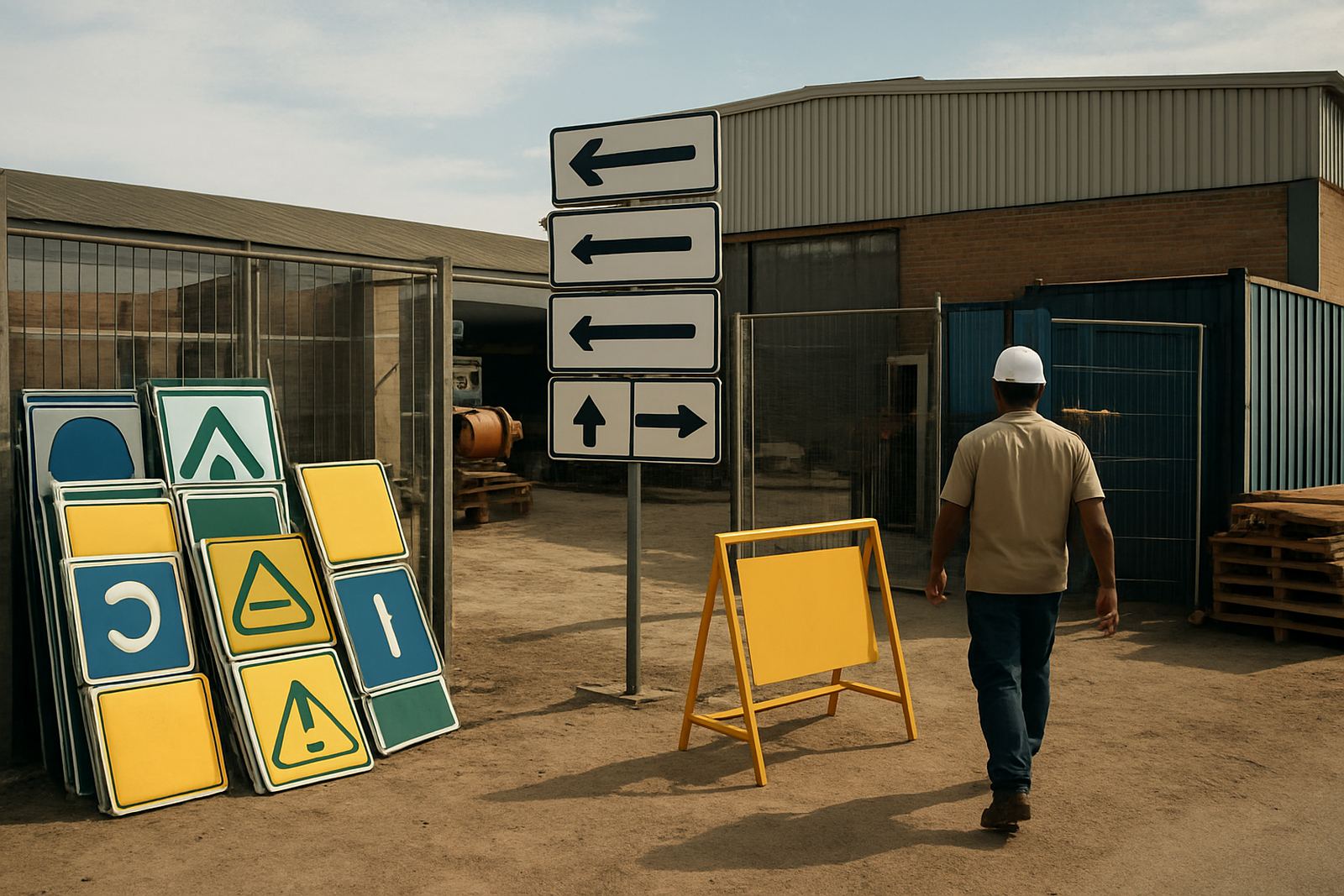
What a construction site needs from day one
On a new build, civils job or fitout site, signage usually starts before the first truck rolls in. You need clear entry points, visible warnings, contractor rules and simple wayfinding for drivers, trades and visitors. In Table View, Milnerton and Blouberg, wind and salt air can shorten the life of cheap printed boards, so material choice matters as much as the wording.
We make temporary and permanent site signage for projects of all sizes, from a small commercial renovation to a multi-unit development. Our team sets up signs for access control, PPE compliance, speed limits, emergency points and restricted areas, with sizes suited to gates, perimeter fencing, hoardings and temporary offices.
- Site entrance boards and contractor notice boards
- Hoarding panels and safety warning signs
- Directional signs for deliveries, parking and pedestrian routes
- Temporary lock-up notices and emergency contact boards
The typical sign set for a working site
A good site pack is built in layers. The first layer gets people in the right place. The second layer keeps them safe. The third layer helps with compliance and day to day control. We often combine printed signs, rigid panels, engraved labels and cut-to-size plastic parts for a practical mix that can handle handling and weather.
For high traffic sites, we usually recommend a mix of Correx boards, aluminium composite panels, reflective safety signs and vinyl applied to fencing or hoarding. Where a sign needs to last longer or be reused on another project, we can produce engraved plastic, routed lettering or light box components for stronger visibility after dark. If the site runs through load-shedding periods, visibility at gates and walkways becomes even more important.
- Temporary site hoarding signs
- Reflective hazard and PPE notices
- Gate and security signage
- Numbered bay signs and plant area markers
- Custom labels for switch rooms, tanks and access panels
Layout planning that saves time on site
Before fabrication starts, it helps to map the site like a person who has never been there. Drivers should know where to stop, workers should know where to sign in, and visitors should not guess where to walk. We look at gate positions, fence lines, parking areas, pedestrian movement and any municipal or landlord requirements before suggesting the sign list.
A few good decisions early on can save a lot of rework later. Keep wording short, make the main instruction larger than the detail, and use contrast that reads in full sun. On coastal projects around Blouberg and Cape Town, glossy faces can glare badly, so finish and colour choice should be planned with the actual site conditions in mind. It is also worth placing signs where trucks can see them before turning, not only once they have already entered the property.
- Put critical signs at eye level and before the decision point
- Use one clear instruction per sign where possible
- Match colours and symbols to the site safety plan
- Allow for wind, dust and routine cleaning
Materials that suit coastal and industrial sites
We machine and finish signs and components in-house, which helps when a project needs odd sizes, shaped panels or repeated reorders. For construction work, the material has to suit the exposure. A short-term interior fitout may only need lightweight board, while a perimeter fence at a coastal site needs something that can survive weather, handling and repeated moving around.
Our workshop also handles engineering plastics, CNC routing and cut-to-size parts, so we can make spacers, brackets, engraved tags and control labels alongside the main signage. For some jobs, sandblasting and engraving are the right answer for a clean, permanent finish. Where the site is exposed to dust or vibration, fixing method is just as important as the face material. A sign is only useful if it stays where it was put up, simple as that.
- Lightweight boards for short term notices
- Rigid panels for hoarding and entrances
- Reflective faces for low-light visibility
- Engineering plastics for labels, tags and controls
- CNC cut components for custom shapes and repeats
Common mistakes that create delays and fines
The most common problem is leaving signage to the end. By then, the site team is rushing, the wording is still changing and the wrong boards get put up just to keep things moving. Another issue is using indoor print on an outdoor site, which fails quickly in wind and rain, especially close to the coast.
We also see signs that are too small, mounted too high, or placed where delivery vehicles cannot see them in time. If the site has multiple contractors, the wording can become inconsistent and confusing. Keep the signs simple and consistent across entrances, fencing and inside the compound. That saves time for the main contractor and helps keep workers moving in the right direction.
- Late ordering and rushed approvals
- Incorrect sizes for the viewing distance
- Poor mounting on temporary fencing
- Too much text and not enough instruction
- Weather-susceptible materials used outdoors
Budget ranges for construction site signage
Costs depend on size, quantity, artwork, material and fixing method. Small temporary signs for a short project is quoted per job each, while more durable safety boards and branded site signs are quoted per job each. Large entrance panels, custom hoarding graphics and engraved wayfinding sets can be quoted per job depending on the finish and number of items. Ask for a quote
For a full site pack, many businesses are quoted per job for basic compliance signs on a compact job to a quoted price for larger developments with multiple gates, hoarding lines and branded access control. If you need repeat signage across several sites in Cape Town, Parklands or Durbanville, it often works out better to plan a standard pack and duplicate it rather than ordering each board separately. Ask for a site-specific quote so the signage matches your layout, not just a generic list. Ask for a quote
We work with businesses across Table View, Milnerton, Blouberg, Montague Gardens, Paarden Eiland and the wider Cape Town area. Enquiries come through the contact page, and we can help plan what should be made now, what can wait, and what needs to be permanent from the start.