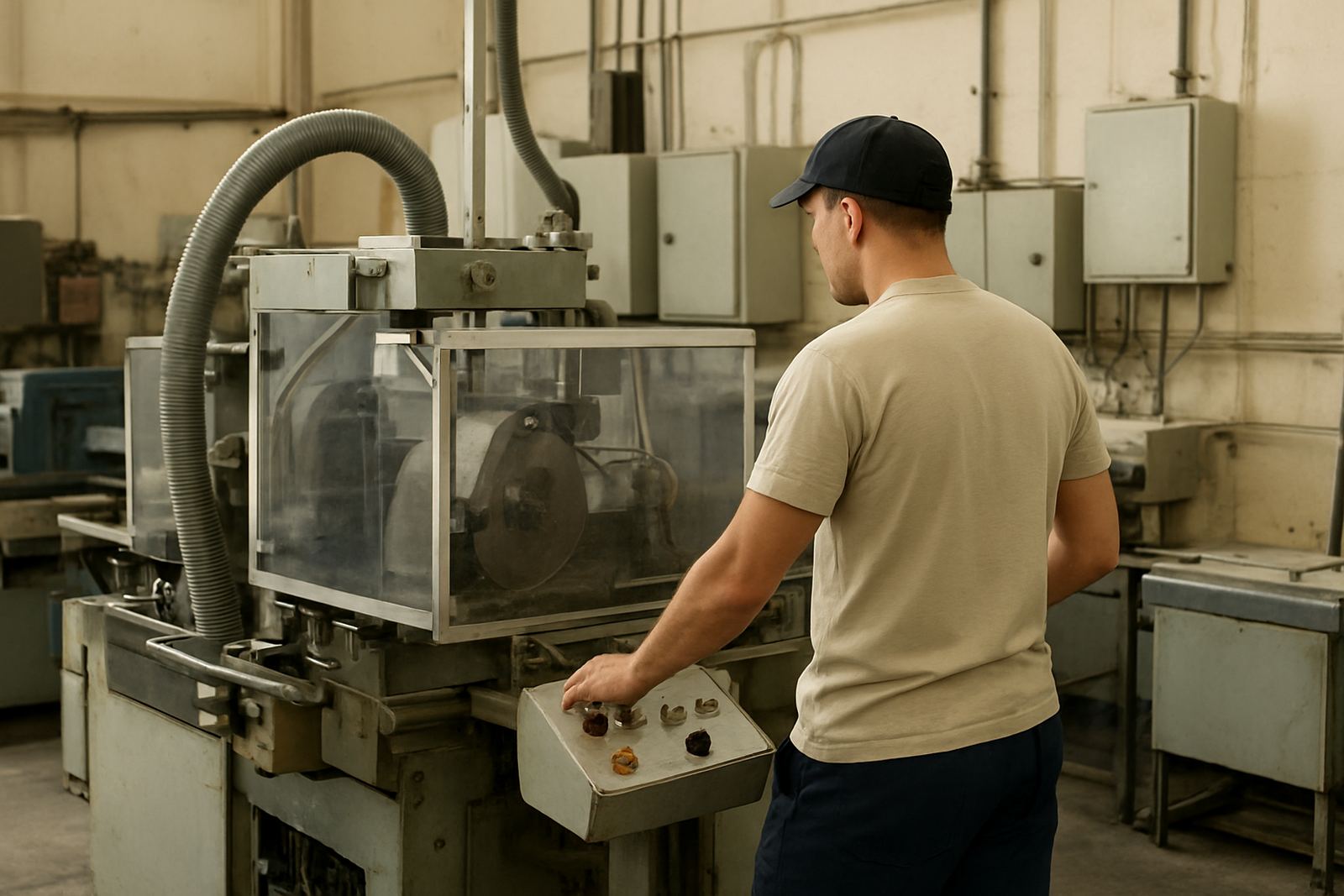
Factory labelling for a busy production floor
The client was a light industrial operation in Killarney Gardens with several machines spread across a packing and processing area. They needed a set of labels that did more than carry names. The brief was to make identification easy for operators, reduce mix-ups during changeovers and give each machine a cleaner, more professional finish.
Because the plant runs daily and cannot afford long downtime, the labelling had to be measured carefully and fitted quickly. We worked from on-site photos, a list of equipment references and the positions where each tag needed to sit. The client also wanted guard plates around some moving sections, so we treated the project as a mix of signage and workshop fabrication.
- Client type: production and packaging facility
- Area: Killarney Gardens, Cape Town
- Job type: engraved tags, machine labels and guard plates
- Application: indoor industrial equipment
What the brief asked us to solve
The main challenge was making the labels readable at a glance while keeping them tough enough for factory use. Some surfaces were flat, others had slight curves or machine housings with limited mounting space. A few areas had heat, light vibration and regular handling by operators wearing gloves, so adhesive-only fixes would not have lasted. The client also wanted the marking to stay legible after cleaning and exposure to workshop grime.
We recommended engraved plastic tags and machine plates with drilled fixing points where mechanical fastening made sense. For guards and exposed edges, we supplied parts with rounded corners and clean cut-outs so they would not snag clothing or trap dust. One section needed a very tight fit around a control cluster, so we allowed for the small tolerances needed in a working plant, not just on paper. That saved time during installation and helped avoid rework.
- Readability from normal standing distance
- Resistance to cleaning chemicals and surface abrasion
- Secure fixing on flat and slightly curved surfaces
- Safe edges on protective parts and covers
Materials, sizes and specs supplied
We manufactured the labels and guard items in engineering plastics selected for industrial use. The engraved tags were cut to size, then routed and engraved in-house so the lettering sat below the surface rather than only being printed on top. That gives better life in a factory, especially where hands, cloths and cleaning rags pass over the same point every day.
Most of the labels were between 80 mm x 30 mm and 180 mm x 60 mm, with a few larger identification panels for wider machine doors. Thickness ranged from 1.6 mm for slim tags up to 3 mm for parts needing more body. Fixings were a mix of countersunk screws and industrial adhesive, depending on the surface and whether the item may need to be removed later. Protective guard pieces were cut with smooth edges and corner radii suited to manual handling. We also supplied a small batch of spare tags for future replacements, which is always worth doing on a site like this.
- Engraved plastic tags and machine plates
- Thickness: 1.6 mm, 2 mm and 3 mm
- Sizes: from 80 mm x 30 mm to 180 mm x 60 mm
- Fixing: screws, countersunk holes and adhesive where suitable
How the workshop handled the turnaround
The project ran over 2 weeks from final sign-off to collection and installation. In week one we confirmed dimensions, prepared the artwork for the tag layouts and set up the cutting and engraving program for the batch. In week two we completed machining, checked each piece against the machine list and arranged installation around the client's production schedule.
Because the site could not stop for a full day, we split the fitting into smaller visits. That allowed the team to work around shift changes and keep the line moving. Our workshop supervisor checked every label before dispatch, and the installation team matched each tag to the correct position on site so there was no confusion once the parts were in hand.
- Week 1: measure-up, layout and job preparation
- Week 2: machining, checking and staged installation
- Installation planned around shift times and access limits
- Final check completed after fitting
Safety details and protective guards
Several of the machines had exposed edges, clear covers or access points where staff needed visual confirmation without leaving parts open. For those areas we produced protective components that sat neatly over the relevant sections while still allowing the operators to see markings and service points. Where a label was likely to be touched often, we kept the edge profile simple and the corners softened to reduce wear.
This kind of work is practical more than decorative. It helps with compliance, cleaner handovers between shifts and less confusion when equipment is stripped for maintenance. We also used spacing and numbering that made sense for the plant's own internal system, rather than forcing a generic layout onto the site. That usually works better in the long run, especially where more than one technician may service the same equipment.
- Guard plates shaped for access and visibility
- Rounded corners to reduce snagging and damage
- Clear numbering for maintenance and operator checks
- Suitable for busy indoor industrial areas
Result on site and what we would repeat
The finished labels gave the plant a cleaner, more organised look and made the equipment easier to identify during operation and maintenance. The client reported that the new marking reduced hesitation during daily checks and made it simpler for staff to point out the correct machine or guard section. The parts sat properly, looked neat and held up through the first round of cleaning and routine use.
For another factory tagging job, we would follow the same measured approach: measure on site, confirm the equipment list before cutting, and supply a few extra spares. That small buffer helps when a tag gets damaged or a new machine is added later. For a factory in Killarney Gardens, that matters because the pace is steady and there is little appetite for redoing simple items twice.
- Better equipment identification across the floor
- Cleaner presentation for staff and visitors
- Spare tags supplied for future changes
- Same process would suit similar plants in Montague Gardens, Paarden Eiland and Milnerton
Key facts
| Project | Killarney Gardens Factory Labels |
|---|---|
| Client type | Light industrial production facility |
| Location | Killarney Gardens, Cape Town |
| Scope | Engraved tags, machine labels, protective guards |
| Materials | Engineering plastics, cut-to-size panels |
| Timeline | 2 weeks from approval to fit-off |